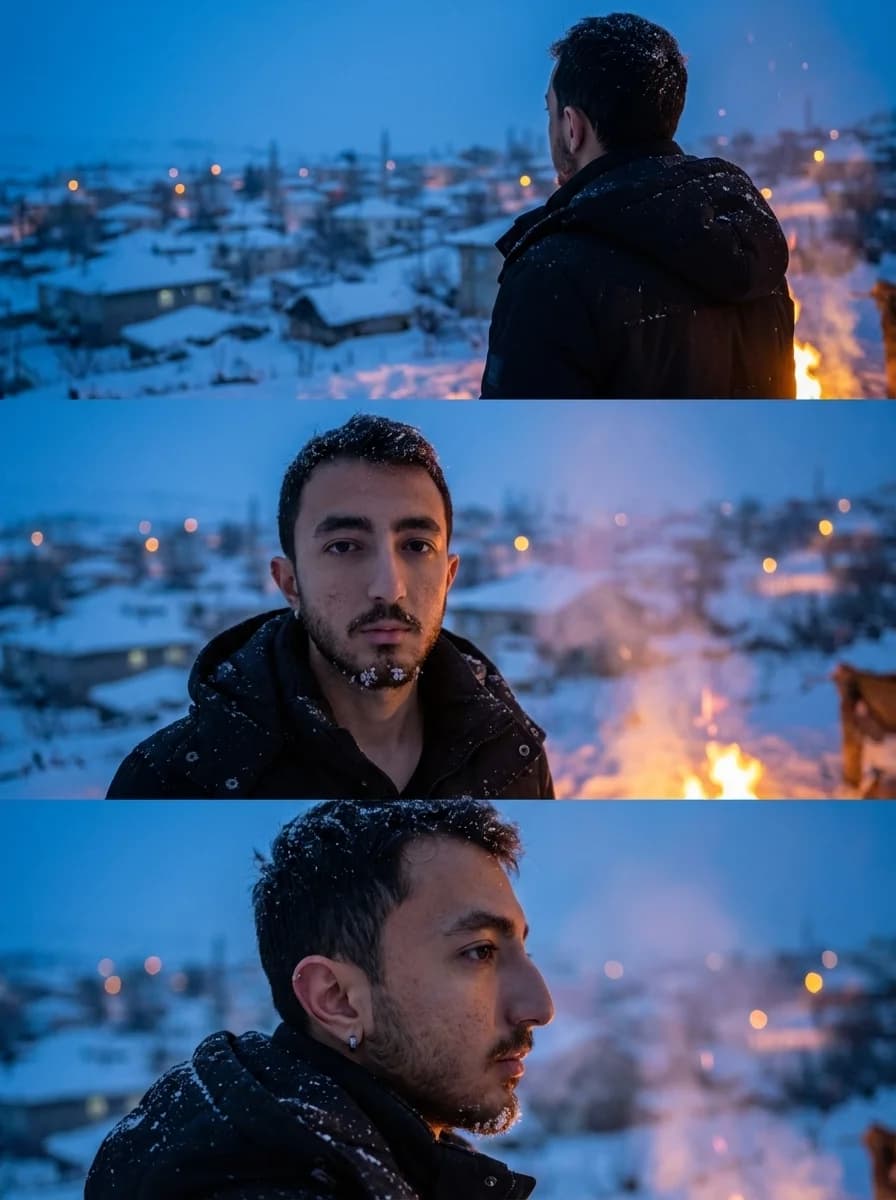
Cinematic Winter Triptych Portrait Prompt - Blue Hour Snow Scene Collage
How to Generate This Image
Set up your AI model
Access Gemini 3 Pro Image or any compatible AI image generation tool
Configure generation parameters
Use the settings shown in the parameters section below
Enter the prompt
Copy the prompt text below and paste it into your AI tool
Generate the image
Click generate and wait 30-60 seconds for your AI-generated image
{
  "metadata": {
    "title": "Cinematic Winter Triptych",
    "genre": "Portrait Collage",
    "style": "Ultra-realistic, Cinematic"
  },
  "composition": {
    "layout_type": "Vertical stack",
    "panels": 3,
    "orientation": "Horizontal panels"
  },
  "subject": {
    "reference": "Use provided user face",
    "demographic": "Male model",
    "attire": "Black jacket",
    "hair": "Dark, slightly tousled by wind, dusted with snow",
    "consistency": "Same character, same clothing across all panels"
  },
  "environment": {
    "location": "Smoky village landscape",
    "area": "Open village area",
    "atmosphere": "Cold, windy, snowy",
    "lighting": "Deep blue evening sky, warm glow from campfire"
  },
  "panel_descriptions": {
    "top_panel": "Upper-body back view facing the distance under a deep blue sky",
    "middle_panel": "Cinematic portrait in same setting (implied)",
    "bottom_panel": "Cinematic portrait in same setting (implied)"
  },
  "full_prompt_text": "Ultra-realistic cinematic winter portrait collage arranged in three horizontal panels stacked vertically, featuring the same male model in every panel. The setting is a smoky village landscape. Top panel: An upper-body back view of the man standing in an open village area, facing the distance under a deep blue evening sky. He wears a black jacket and his dark hair is visible, slightly tousled by the cold wind and dusted with snow, illuminated by a nearby campfire. The man maintains consistent facial features and clothing across the collage. 8k resolution, highly detailed."
}AI Model
Gemini 3 Pro Image
Source
https://x.com/lexx_aura/status/1992986148650815572Generation Parameters
Tags
Metadata and Statistics
About the Author
Frequently Asked Questions
What is a portrait triptych and why use this format?
A portrait triptych is a three-panel composition showing the same subject from different angles or in sequential moments. This format is powerful because it provides visual variety while telling a cohesive story, showcases subject dimensionality through multiple perspectives (back view creates mystery, frontal creates connection, profile creates contemplation), prevents viewer boredom with repeated visual interest, and feels complete and intentional. In winter photography specifically, triptychs allow capturing the atmospheric conditions from multiple angles while maintaining consistent environmental mood.
What is blue hour and why is it ideal for winter portraits?
Blue hour is the period just after sunset (or before sunrise) when the sky turns deep, rich blue before full darkness. It's ideal for winter portraits because: the soft, diffused light eliminates harsh shadows, the deep blue color provides beautiful contrast with warm artificial lights (campfires, village lights), it creates emotional atmosphere suggesting twilight and transition, it's naturally occurring during practical outdoor times in winter, and the color is inherently photogenic and cinematic. Blue hour typically lasts 20-40 minutes, requiring careful timing.
How do you create consistent characters across multiple triptych panels?
Consistency across triptych panels requires: using the same reference image or detailed description for all panels, explicitly specifying that facial features, clothing, and styling must remain identical, maintaining the same lighting conditions and atmospheric elements, keeping the same environmental setting and time of day, and using AI platforms or settings that support multi-image consistency (like reference images or style seeds). Without explicit consistency instructions, AI may generate slightly different versions that break the triptych illusion.
What makes campfire lighting effective in winter portraits?
Campfire lighting works exceptionally well in winter portraits because: it provides warm orange-gold illumination that contrasts beautifully with cool blue winter atmosphere, it creates soft, directional, natural-looking light rather than harsh artificial lighting, it adds narrative context (warmth, survival, gathering, contemplation), it motivates why someone stands outside in cold conditions, it creates dimensional modeling with gentle falloff, and it adds visual interest through dynamic flames and smoke. The warm-cool temperature contrast is particularly pleasing to human vision.
How should falling snow be captured in portrait photography?
Effective falling snow in portraits requires: varying focus (some flakes sharp, others blurred) to create depth, showing snow at different distances from camera, capturing snow interaction with light (backlit, catching fire glow), showing accumulation on subject (jacket, hair, shoulders) for authenticity, using fast enough shutter to freeze some flakes while allowing slight motion blur on others, and avoiding oversaturation (too much snow obscures subject). Snow should add atmosphere without overwhelming the portrait.
What panel order works best for portrait triptychs?
Effective panel order typically follows narrative logic: back view first creates mystery and establishes setting, frontal portrait second provides emotional connection and face reveal, profile third offers contemplative conclusion. However, alternatives work: chronological action sequence, varying distance (wide to close-up), lighting progression, or emotional arc. The key is intentional ordering that creates flow and tells a story rather than random arrangement. Test different orders to see which creates the most compelling narrative for your specific content.
How can I customize this winter triptych for different seasons or settings?
Keep the three-panel structure and consistent character requirements while changing environmental details: Spring—blooming trees, rain instead of snow, golden hour instead of blue; Summer—bright daylight, beach or meadow setting, backlit sunset; Autumn—falling leaves, golden hour, forest setting; Desert—sunset light, sand dunes, warm tones; Urban—city lights, rooftop, neon reflections. Adjust the atmospheric elements (precipitation, light quality, color temperature) while maintaining the triptych format's narrative power.
What technical specifications ensure professional triptych quality?
Professional triptych quality requires: 8K resolution minimum for large prints and crops, ultra-realistic rendering with attention to skin texture, fabric detail, and environmental authenticity, shallow depth of field (f/2.8-f/4) for atmospheric bokeh, proper color temperature balance (cool blues vs warm oranges), consistent lighting across all panels, natural light physics (proper shadows, highlights, and ambient occlusion), and careful attention to compositional balance where each panel works independently and together. Specify these technical details explicitly in prompts for best results.
Share this prompt
Share this prompt on social media or copy the link to share with friends